

Source post used
1) Techniques from the post
From the startup-performance post, the concrete techniques are:
Refactor and optimize startup data loading (especially pre-warmed clients with local DB data).
Switch build system to improve bundle output (Linear moved Parcel → Rollup; for us this means evaluating best bundling config/tooling for startup + size).
Lazy-load infrequently used app code and infrequently used data.
Target modern browser/runtime capabilities to avoid shipping legacy transforms/polyfills where unnecessary.
Improve dead code elimination (tree-shaking).
Code-split by route/feature boundaries.
Preload code before it is needed (intent-based prefetch/preload).
Scale/architecture follow-up from the large-workspace post:
Treat large-workspace scaling as first-class architecture work (not only micro-optimizations).
Continuously profile and remediate hot paths for large datasets.
2) What fits Web vs Electron
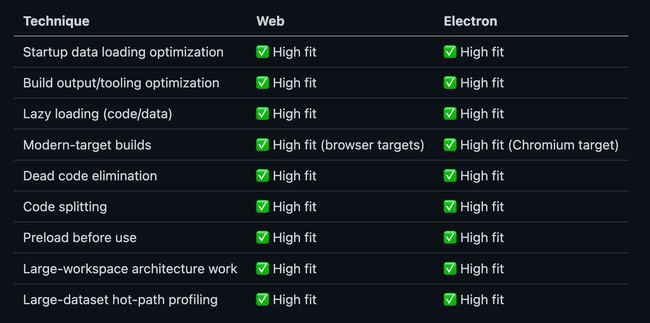
Notes:
Web has more network variance pressure, so preload strategy must be bandwidth-aware.
Electron has stronger control of runtime (Chromium version) and benefits heavily from deterministic startup work and memory discipline.
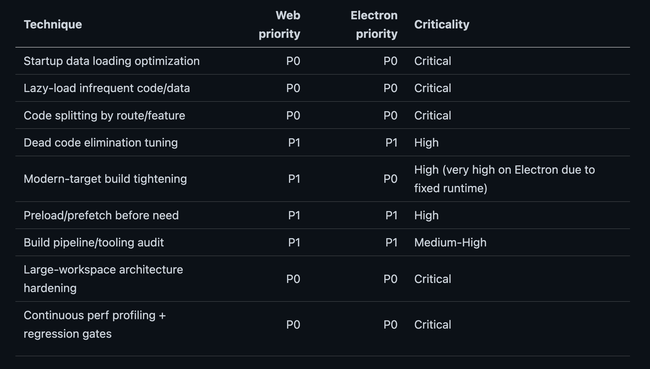
3) Per-app priority / criticality
Legend: P0 = must do now, P1 = should do next, P2 = nice follow-up
4) Phased implementation plan
Phase 0 — Baseline & guardrails (1 week)
Define SLOs: warm startup, cold startup, first interactive list, memory steady-state.
Add measurement in both apps (same metric names; per-workspace-size segmentation).
Create “small / medium / large workspace” test fixtures.
Exit criteria: Reliable baseline dashboards + repeatable local benchmark script.
Phase 1 — Startup critical path (1–2 weeks)
Reduce synchronous startup work.
Defer non-critical initialization.
Optimize local data hydration path for pre-warmed sessions.
Exit criteria: Meaningful warm-start improvement on both Web and Electron.
Phase 2 — Bundle strategy (1–2 weeks)
Audit bundle graph by route/feature.
Enforce route/feature code splitting.
Tighten modern targets and tree-shaking settings.
Exit criteria: Lower initial JS bytes and faster cold start.
Phase 3 — Lazy data/code + preload strategy (1–2 weeks)
Lazy-load rarely used views/features/data.
Add intent-based preloading (hover/soon-to-open routes/workflows).
Cap aggressive prefetch on constrained networks.
Exit criteria: Faster perceived navigation with no significant bandwidth regressions.
Phase 4 — Large-workspace scalability hardening (2+ weeks, parallel track)
Profile pathological large-workspace flows.
Rework heavy list/filter/sync hot paths.
Add scalability regression tests in CI datasets.
Exit criteria: No severe degradation moving from medium to large workspace fixtures.
Phase 5 — Rollout & regression control (ongoing)
Feature-flag each major perf change.
Roll out progressively (internal → beta cohort → % rollout).
Alert on startup, interaction latency, and memory regressions.
Exit criteria: Stable production metrics post-rollout.
Recommended immediate execution order
Phase 0 + Phase 1 (highest ROI, lowest product risk).
Phase 2 + Phase 3 (bundle and loading behavior).
Phase 4 in parallel once baseline instrumentation is stable.
Keep Phase 5 always on.
Do you like what you are reading? Subscribe to receive updates.
Unsubscribe anytime